
How to do a systematic review, step by step
You’re starting your first systematic review and want the whole process in order. There are eleven steps. The decisions that matter most go into the protocol, before anyone screens a record, so it helps to know what the later steps need before you write it.
Updated
In brief
- A systematic review answers a clearly formulated question with explicit methods, planned in a protocol before you see any results.
- Register the protocol before screening starts. PROSPERO won’t accept it once data extraction has begun.
- Search several sources, screen titles and abstracts generously, and have two people decide on each full text independently.
- Extract outcome data and assess risk of bias in duplicate, and meta-analyse only where the studies allow it.
- Rate certainty for each outcome with GRADE, and report against PRISMA 2020.
How to do a systematic review in 11 steps
PRISMA 2020 defines a systematic review as “a review that uses explicit, systematic methods to collate and synthesise findings of studies that address a clearly formulated question”. You fix those methods in advance and keep records good enough for someone else to repeat the work.
Each step produces what the next needs, and a few loop back. A pilot can show that a criterion needs rewording, the reference lists of included studies can turn up studies the databases missed, and Cochrane expects searches over 12 months old at publication to be rerun.
- Plan1Question2Protocol and registration
- Find and select3Search4Remove duplicates5Title and abstract screeningBack to 2: pilot shows a criterion is unclear, so reword it and record the amendment6Full-text screeningBack to 3: search reference lists and citations of included studies
- Analyse7Data extraction8Risk of biasOn to 10: risk of bias is one of the five GRADE domains9Synthesismeta-analysis if appropriate10Certainty (GRADE)
- Report11Report (PRISMA 2020)Back to 3: rerun searches if the last one is over 12 months old
| Step | Output | Guide |
|---|---|---|
| 1. Frame the question | A focused question and eligibility criteria | PICO criteria |
| 2. Write and register a protocol | A registered protocol covering every later step | Protocol |
| 3. Search | Strategies as run, with dates and record counts | Search strategy |
| 4. Remove duplicates | One record per report, and a duplicate count | PRISMA flow diagram |
| 5. Screen titles and abstracts | Reports to retrieve, and a count of exclusions | Title and abstract screening |
| 6. Screen full texts | Included studies, and a reason for each exclusion | Full-text screening |
| 7. Extract data | Each study’s data, with where it came from | Data extraction form |
| 8. Assess risk of bias | A judgement for each result, with its support | Risk of bias tools |
| 9. Synthesise | A meta-analysis or other synthesis, with tables or plots | Handbook chapters 10 and 12 |
| 10. Rate certainty | A GRADE rating for each important outcome | Handbook chapter 14 |
| 11. Report | A manuscript checked against PRISMA 2020 | PRISMA flow diagram |
Systematic review steps, what each produces, and where it’s covered.
1. Frame the question
- Output
- A focused question and eligibility criteria
- Guide
- PICO criteria
2. Write and register a protocol
- Output
- A registered protocol covering every later step
- Guide
- Protocol
3. Search
- Output
- Strategies as run, with dates and record counts
- Guide
- Search strategy
4. Remove duplicates
- Output
- One record per report, and a duplicate count
- Guide
- PRISMA flow diagram
5. Screen titles and abstracts
- Output
- Reports to retrieve, and a count of exclusions
6. Screen full texts
- Output
- Included studies, and a reason for each exclusion
- Guide
- Full-text screening
7. Extract data
- Output
- Each study’s data, with where it came from
- Guide
- Data extraction form
8. Assess risk of bias
- Output
- A judgement for each result, with its support
- Guide
- Risk of bias tools
9. Synthesise
- Output
- A meta-analysis or other synthesis, with tables or plots
- Guide
- Handbook chapters 10 and 12
10. Rate certainty
- Output
- A GRADE rating for each important outcome
- Guide
- Handbook chapter 14
11. Report
- Output
- A manuscript checked against PRISMA 2020
- Guide
- PRISMA flow diagram
Not sure a systematic review fits your question? Read scoping review vs systematic review first.
1. Frame the question
Start with a question that matters to the people who’ll use the answer, framed tightly enough to tell you which studies count. For intervention questions, chapter 1 of the Cochrane Handbook says the PICO approach (population, intervention, comparison, outcome) is usually used. Its elements then become your eligibility criteria.
The mistake to avoid is fitting the question to studies you already know. The Handbook warns that prior knowledge of the evidence can shape the question and the criteria, and that “the review question should determine the methods used in the review, and not vice versa.” Check PROSPERO for an existing review on your question, then turn it into eligibility criteria with PICO.
2. Write a protocol and register it
The protocol fixes your methods before you see any results, including the risk of bias tool, the synthesis, any subgroup analyses and how you’ll grade certainty. Cochrane makes planning each of those in advance mandatory, and PRISMA-P gives a 17-item checklist of what to report.
Methods shouldn’t change once results are visible. The Handbook calls post hoc decisions “highly susceptible to bias”. Track and date any change you can’t avoid, as PRISMA-P asks, and report it under PRISMA 2020 item 24c. Writing a systematic review protocol has the detail.
Pitfall: Registering too late, or too early
PROSPERO wants a complete protocol and won’t accept a review once data extraction has started. It treats a review as starting after the protocol is finished and before formal screening begins, so register in that window. Don’t register before you have the people or funding to finish.
3. Search more than one database
The search aims for high sensitivity and accepts low precision. Chapter 4 of the Cochrane Handbook recommends working with an information specialist from the start, and says MEDLINE alone isn’t adequate. Cochrane reviews should search CENTRAL and MEDLINE, Embase where the team has access, and trials registers.
A typical MEDLINE strategy combines terms for the condition, the intervention and the study design. Adding comparators or outcomes just to shrink a large result set can lose studies, because those concepts are often missing from abstracts or poorly indexed. For every source, keep:
- the strategy exactly as run, copied and pasted, never retyped;
- the date you searched it;
- the number of records it returned.
Searching doesn’t need two people in parallel, but the Handbook strongly recommends having each strategy peer reviewed before it’s run. The detail is in building a search strategy.
4. Remove duplicate records
Merge the results from all your sources in reference management software and remove duplicates, counting them before you delete anything, because the PRISMA flow diagram reports them. PRISMA 2020 treats records as duplicates only when they refer to the same report:
| Records | Duplicates? |
|---|---|
| The same journal article, found in two databases | Yes. Keep one record. |
| A trial’s protocol paper and its results paper | No. They’re two reports of one study, linked after full-text retrieval. |
| Similar abstracts submitted to two conferences | No. PRISMA treats them as unique. |
5. Screen titles and abstracts
Remove the records that are obviously irrelevant and send everything else on. The Handbook advises being over-inclusive, so a record whose abstract doesn’t mention a criterion should go forward. One person can do this first screen under Cochrane’s standards, though two working independently is ideal, and exclusions only need counting. The title and abstract screening guide covers decision rules and calibration.
6. Decide on the full texts
At full-text screening, retrieve every report that passed the first screen, link reports of the same study, and decide whether each study meets the criteria. At least two people must make this final decision independently, using a rule for disagreements agreed in advance, and each exclusion gets one primary reason.
A study shouldn’t be excluded only because it doesn’t report outcome data in a usable form. Cochrane’s standard is to include it, because leaving it out risks bias from selective outcome reporting.
7. Extract the data
Build the extraction form from outlines of the tables and figures you plan to publish, pilot it, and record where in each report every value was found. Avoid a single extractor. The Cochrane Handbook notes that extraction errors are “rarely detected by peer reviewers, editors, or users of systematic reviews”, and Cochrane makes independent extraction by at least two people mandatory for outcome data.
8. Assess risk of bias
Judge the risk that each included study’s results overestimate or underestimate the true effect, using a tool built for its design.
| Study design | Tool Cochrane recommends |
|---|---|
| Randomised trials | RoB 2 |
| Non-randomised studies of interventions | ROBINS-I |
Both use fixed bias domains with signalling questions, and usually judge a specific result, since bias can vary with how an outcome was measured or analysed. Don’t reduce either to a quality score. Chapter 7 of the Handbook explains that early quality scales combined several features into one number, and that the scale chosen could change how a meta-analysis was interpreted. At least two people should assess each result independently.
9. Synthesise the results, with a meta-analysis if it fits
A systematic review and meta-analysis is a systematic review whose synthesis includes a meta-analysis, which chapter 10 of the Cochrane Handbook defines as “the statistical combination of results from two or more separate studies”. The earlier steps don’t change, but the protocol has to say in advance whether you’ll pool results, with which effect measures, how you’ll assess heterogeneity and which model you’ll fit. That chapter opens with a section headed “Do not start here!”, because a meta-analysis can be very misleading if the earlier steps weren’t done with care.
When results are incompletely reported, or reported with different effect measures, a meta-analysis may not be possible. Chapter 12 describes acceptable alternatives:
- summarising the effect estimates with statistics such as the median and range;
- combining P values;
- vote counting based on the direction of effect alone.
Don’t count votes by statistical significance, which the Handbook rules unacceptable because it can lead to the wrong conclusion. Heterogeneity is often cited as a reason to skip a meta-analysis, but the Handbook says meta-analysis should still be considered. Whatever you do, show each study’s results in tables or plots alongside the synthesis.
10. Rate the certainty of the evidence with GRADE
For each important outcome, rate how confident you can be that the estimated effect is close to the one you set out to measure. In GRADE, which Cochrane uses, evidence from randomised trials starts high and evidence from non-randomised studies starts low. You rate down for risk of bias, inconsistency, indirectness, imprecision or publication bias, ending at high, moderate, low or very low, as chapter 14 of the Handbook describes. Non-randomised evidence can occasionally be rated up.
A single rating for the whole review is a mistake, since GRADE rates each outcome separately. Pick the outcomes for your summary of findings table in the protocol, seven at most, and never by the size of their effects.
11. Write the review to PRISMA 2020
Writing a systematic review means giving “a transparent, complete, and accurate account” of why you did it, what you did and what you found. PRISMA 2020, which replaces PRISMA 2009, sets out what that account contains in a 27-item checklist and a flow diagram. It isn’t a guide to conducting a review, but its authors say knowing it helps you capture what you’ll need, and some items depend on records kept as you go:
- full search strategies for every database, register and website (item 7);
- how many people screened each record and report, and whether independently (item 8);
- the counts for the flow diagram (item 16a);
- every protocol amendment, with its reason (item 24c).
Can you do a systematic review alone?
Not to Cochrane’s standard. Chapter 1 of the Handbook says Cochrane “will not publish a review that is proposed to be undertaken by a single person”. With a team, at least two people can independently select studies, extract data and rate certainty, which reduces errors.
| Step | What Cochrane expects |
|---|---|
| Search | One searcher, with the strategy peer reviewed before it’s run |
| Title and abstract screening | One person acceptable, two independently ideal |
| Full-text decisions | At least two, independently (mandatory) |
| Extracting outcome data | At least two, independently (mandatory) |
| Extracting study characteristics | At least two, independently (highly desirable) |
| Risk of bias | At least two, independently (mandatory) |
| Certainty (GRADE) | Ideally two, independently |
PRISMA 2020 sets no minimum, because it’s a reporting guideline. If you’re a student working mostly alone, ask a supervisor or peer to be second reviewer for the mandatory steps, and read using AI in systematic reviews responsibly before using AI for any of them.
What to report: What to report about who did what
PRISMA 2020 items 8, 9 and 11 ask how many reviewers screened, collected data and assessed risk of bias, whether they worked independently, and what automation tools were used. If one person did a step, say so.
How long does a systematic review take?
Often more than a year. A 2017 analysis of 195 published reviews registered on PROSPERO found a mean of 67.3 weeks from the registered start date to publication, ranging from 6 to 186 weeks. Your own timeline depends on:
- how many records your searches return;
- how many studies you include, each extracted and assessed in duplicate;
- how quickly you get full texts, and answers from study authors;
- how many people work on it, and for how many hours.
If more than 12 months pass between your last search and publication, Cochrane expects you to rerun it.
Example: A rough screening estimate
Say your searches return 4,000 records after deduplication. At the Handbook’s conservative rate of one or two abstracts a minute (60 to 120 an hour), one person needs about 33 to 67 hours to screen them once. Two independent screeners double that, and the full texts come on top.
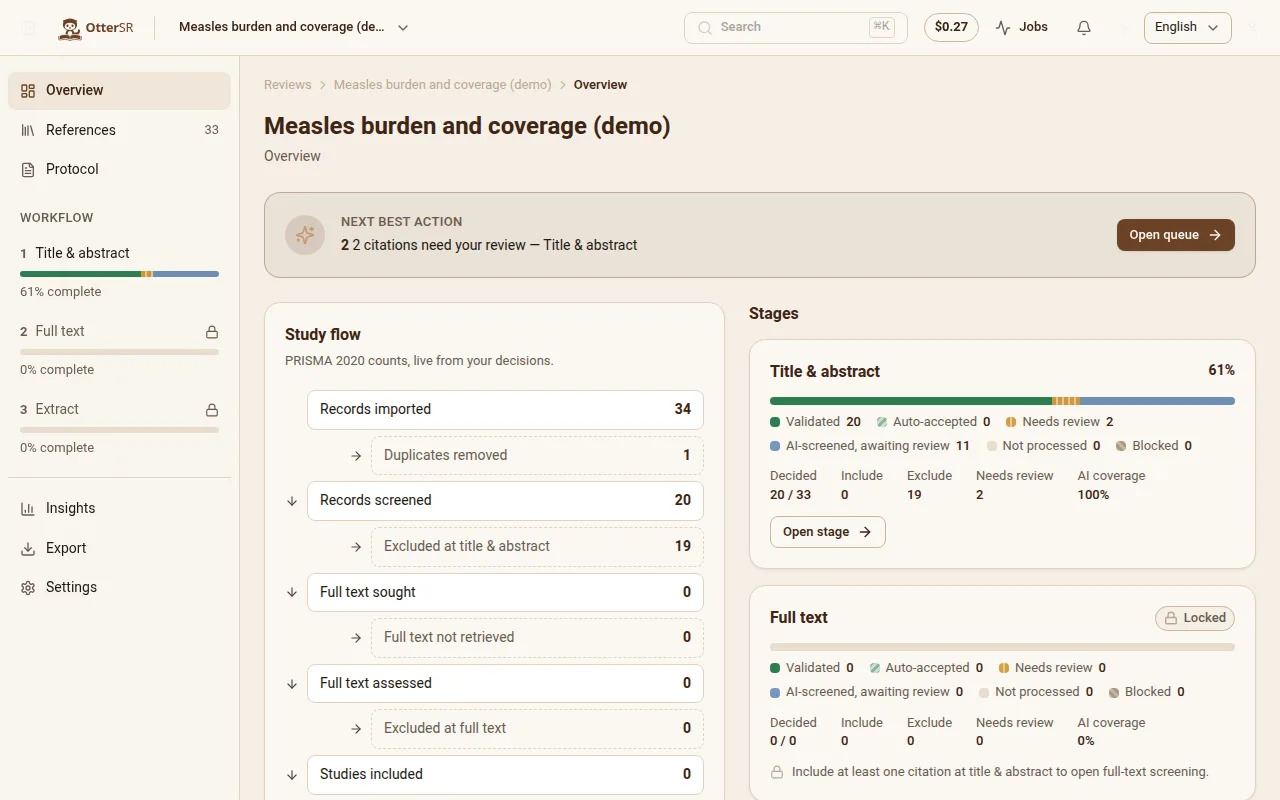
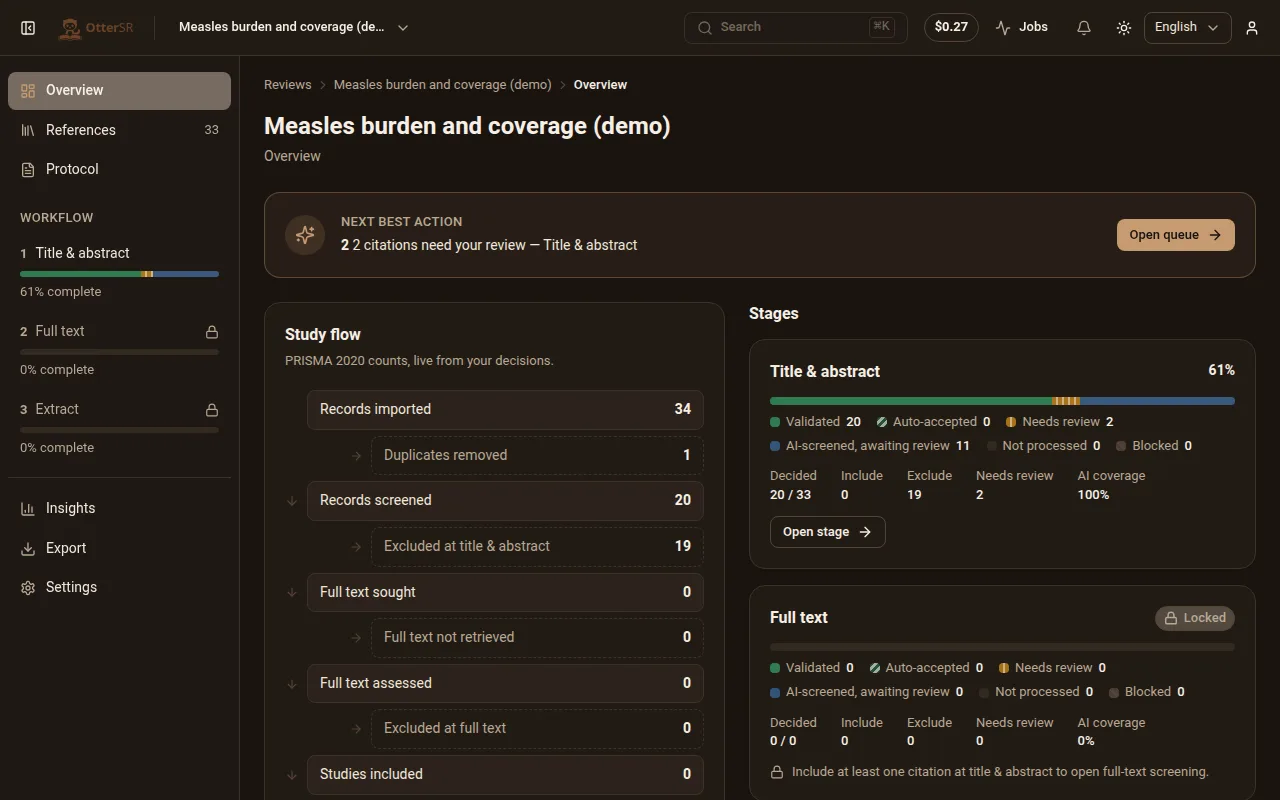
Doing this in OtterSR
OtterSR covers the work from importing references to writing up. You import a file or search databases from inside the app, then confirm the duplicates it groups. Removal is a soft delete, so duplicates still count in the PRISMA flow.
At both screening stages, the AI proposes an answer to each protocol question with the passage it came from, and you accept it or choose another. Extracted values cite their source passage too. The Write stage can run the meta-analysis, with subgroup, sensitivity and small-study analyses, and make tables, forest and funnel plots and PRISMA figures from your data. For step 8, its Risk of bias tab has the AI answer each signalling question with the passages it rests on, for a person to confirm. For step 10, Write can build a summary of findings table, but its GRADE ratings stay marked as proposed until a person accepts them. See how it works and pricing.
Free tools for this step
- Forest plot generatorUse this when you have several studies of the same comparison and want them pooled, with heterogeneity, and drawn as a forest plot.
- PRISMA flow diagram generatorUse this when your manuscript needs a PRISMA 2020 flow diagram and you want its numbers checked before a reviewer does.
- GRADE summary of findings tableUse this when you’ve rated the certainty of each outcome with GRADE and need the summary of findings table, with absolute effects per 1000.
Related guides
- How to do a meta-analysis: a step-by-step guideHow to do a meta-analysis: deciding whether to pool, choosing the effect measure, fixed or random effects, heterogeneity, sensitivity analyses and reporting.
- How to rate the certainty of evidence with GRADEHow GRADE rates the certainty of evidence per outcome: four levels, five reasons to rate down, three to rate up, and what goes in a summary of findings table.
- How to write the results, discussion and abstract of a systematic reviewThe results, discussion and abstract of a systematic review, item by item against PRISMA 2020 and PRISMA 2020 for Abstracts, with wording for certainty.
Sources
- Page MJ, McKenzie JE, Bossuyt PM, et al. The PRISMA 2020 statement: an updated guideline for reporting systematic reviews. BMJ 2021;372:n71. https://doi.org/10.1136/bmj.n71
- Lasserson TJ, Thomas J, Higgins JP. Chapter 1: Starting a review [last updated August 2021]. In: Higgins JP, Thomas J, Chandler J, et al (editors). Cochrane Handbook for Systematic Reviews of Interventions version 6.5. Cochrane, 2024. https://www.cochrane.org/authors/handbooks-and-manuals/handbook/current/chapter-01
- Lefebvre C, Glanville J, Briscoe S, et al. Chapter 4: Searching for and selecting studies [last updated March 2025]. In: Higgins JP, Thomas J, Chandler J, et al (editors). Cochrane Handbook for Systematic Reviews of Interventions version 6.5.1. Cochrane, 2025. https://www.cochrane.org/authors/handbooks-and-manuals/handbook/current/chapter-04
- PROSPERO, International prospective register of systematic reviews. Guidance for registering human studies. Centre for Reviews and Dissemination, University of York. https://www.crd.york.ac.uk/prospero/documents/Guidance%20for%20registering%20human%20studies.pdf
- Moher D, Shamseer L, Clarke M, et al. Preferred reporting items for systematic review and meta-analysis protocols (PRISMA-P) 2015 statement. Systematic Reviews 2015;4:1. https://doi.org/10.1186/2046-4053-4-1
- Li T, Higgins JP, Deeks JJ. Chapter 5: Collecting data [last updated October 2019]. In: Higgins JP, Thomas J, Chandler J, et al (editors). Cochrane Handbook for Systematic Reviews of Interventions version 6.5. Cochrane, 2024. https://www.cochrane.org/authors/handbooks-and-manuals/handbook/current/chapter-05
- Boutron I, Page MJ, Higgins JP, Altman DG, Lundh A, Hróbjartsson A. Chapter 7: Considering bias and conflicts of interest among the included studies [last updated August 2022]. In: Higgins JP, Thomas J, Chandler J, et al (editors). Cochrane Handbook for Systematic Reviews of Interventions version 6.5. Cochrane, 2024. https://www.cochrane.org/authors/handbooks-and-manuals/handbook/current/chapter-07
- Deeks JJ, Higgins JPT, Altman DG, McKenzie JE, Veroniki AA, Simmonds M (editors). Chapter 10: Analysing data and undertaking meta-analyses [last updated November 2026]. In: Higgins JPT, Thomas J, Chandler J, et al (editors). Cochrane Handbook for Systematic Reviews of Interventions version 6.5.1. Cochrane, 2026. https://www.cochrane.org/authors/handbooks-and-manuals/handbook/current/chapter-10
- McKenzie JE, Brennan SE. Chapter 12: Synthesizing and presenting findings using other methods [last updated October 2019]. In: Higgins JP, Thomas J, Chandler J, et al (editors). Cochrane Handbook for Systematic Reviews of Interventions version 6.5. Cochrane, 2024. https://www.cochrane.org/authors/handbooks-and-manuals/handbook/current/chapter-12
- Schünemann HJ, Higgins JP, Vist GE, et al. Chapter 14: Completing ‘Summary of findings’ tables and grading the certainty of the evidence [last updated August 2023]. In: Higgins JP, Thomas J, Chandler J, et al (editors). Cochrane Handbook for Systematic Reviews of Interventions version 6.5. Cochrane, 2024. https://www.cochrane.org/authors/handbooks-and-manuals/handbook/current/chapter-14
- Borah R, Brown AW, Capers PL, Kaiser KA. Analysis of the time and workers needed to conduct systematic reviews of medical interventions using data from the PROSPERO registry. BMJ Open 2017;7(2):e012545. https://doi.org/10.1136/bmjopen-2016-012545