
Using AI in systematic reviews responsibly
Say you want an AI tool to help screen several thousand records. It can take real work out of the review, mostly by putting records in order and proposing answers for a person to check. Using it responsibly means a person checks what it produces. You also have to test it on your own review first, and report exactly what it did.
Updated
In brief
- AI is most useful for prioritising records, and for proposing screening answers or extraction values for a person to check.
- You’re still responsible for the review, including the decision to use AI.
- Test any tool on a sample from your own review before relying on it, and keep checking as you go.
- Report the tool, its version, when you used it, what it did and how you validated it.
- Guidance is recent and still developing. Agree your plan with your supervisor or co-authors before you start.
What current guidance says
In 2025, Cochrane, the Campbell Collaboration, JBI and the Collaboration for Environmental Evidence published a joint position statement on AI use in evidence synthesis, simultaneously in their journals. It supports the aims of the RAISE recommendations (Responsible use of AI in evidence SynthEsis). RAISE is a set of three documents, made up of recommendations for each role in evidence synthesis, guidance on building and evaluating AI tools, and guidance on selecting and using them.
For people doing reviews, the statement’s main points are these:
- “Evidence synthesists are ultimately responsible for their evidence synthesis”, including the decision to use AI.
- AI and automation in evidence synthesis “should be used with human oversight”.
- You can use AI as long as you can demonstrate that it won’t compromise the methodological rigour or integrity of your synthesis.
- Any use of AI or automation that makes or suggests judgements should be fully and transparently reported.
Both the statement and RAISE are expected to change as the field and the evidence develop, and the statement says the most up-to-date versions should always be used. Check for a newer version before you rely on either.
The Cochrane Handbook, in text written in mid-2023, said that no sufficiently large and valid evaluations were yet available for tools built on large language models. It also said that using active learning to eliminate records automatically hadn’t been recommended for Cochrane reviews, because safe stopping rules still needed to be developed and validated.
Where AI helps
- Active learning tools re-rank records as you screen, so likely includes come first. That’s useful even without automatic elimination, because you find the studies most likely to be included much earlier.
- A tool can propose an answer to each eligibility question, with the sentence it relied on, for a person to accept or change.
- For extraction, a tool can propose a value for each field with the passage it came from, so the person checking can go straight to the source.
- Tools can also classify records. Cochrane reviews use a classifier that identifies reports of randomised trials from their titles and abstracts.
The Handbook cites research, published in 2015, suggesting that automation can reduce the need for manual screening by at least 30% and possibly more than 90%, although sometimes at the cost of up to a 5% reduction in sensitivity.
The evidence for extraction is thinner. The Handbook’s chapter on collecting data, last updated in 2019, reported that each tool covered only a few data elements, and that most flagged sentences instead of filling in forms. It couldn’t recommend a specific tool for routine use, and suggested such tools might first act as checks on manual extraction.
Why a person must check
Pitfall: AI tools make mistakes that look right
A tool can attach a number to the wrong group, or take a figure from the abstract that differs from the full text. It can even produce a value that isn’t in the paper at all. A high confidence score doesn’t make an answer correct.
Screening errors are lopsided. A record wrongly included is caught at full text. A record wrongly excluded is never seen again, and nothing later in the review will reveal it. That’s why exclusions made by a tool need the most scrutiny, and why the PRISMA 2020 flow diagram asks you to say how many records were excluded by automation tools and how many by people.
Responsibility sits with the review team, so every decision needs a person who made it and can explain it.
Validate it on your own review
A tool’s published performance was measured on someone else’s reviews. Your topic may be different. So may the way abstracts in your field are written, and how strict your criteria are. The position statement asks you to be critical of a tool’s evaluations, its limitations and whether it applies to the context of your review, and to consider independent evaluations where they exist. Depending on how certain you are, it says, you may need to “pilot (or calibrate) the AI system or tool to validate its performance”.
For screening, a simple validation looks like this:
- Before relying on the tool, have people screen a sample of your records without seeing its output. Draw the sample at random, and make it large enough to contain a reasonable number of includes.
- Compare the tool’s decisions with theirs. The figure that matters most is sensitivity (also called recall), the share of the records people included that the tool also included.
- Read every record the tool missed, and work out why. A pattern, such as a study design or a population term it keeps missing, often points to a fix in the criteria or the instructions.
- Decide before you test what result you’ll accept, and what you’ll do if the tool falls short, such as keeping a second human screener.
- Keep checking. Take further samples as the review goes on, especially if your criteria or the tool’s version change.
For extraction, compare the tool’s values with independent human extraction on your pilot studies, field by field. Take particular care over numbers, and over which group each number belongs to.
What to report: Small samples give uncertain estimates
Report the sample size with every figure, and if a tool scores perfectly on a handful of includes, test it on more.
Report it transparently
PRISMA 2020 asks for details of any automation tools used in selecting studies (item 8) and in collecting data (item 9). The position statement lists what, in general, to report:
- the name of each AI system or tool, its version, and the dates you used it;
- why you used it, and which parts of the review it affected;
- the justification for using it, including evidence that it is methodologically sound, and how you validated it for your review;
- where possible, the inputs such as prompts, the outputs, datasets and code, and the steps you took to verify what it produced;
- any financial or non-financial interests you have in the tool, and its funding sources;
- its limitations, including potential biases, and their likely impact.
Say in your protocol how you plan to use AI, and if the plan changes, report it as an amendment. For how automated exclusions appear in the diagram, see the PRISMA 2020 flow diagram, explained.
What to tell your supervisor or ethics board
If you’re a student, or your review sits inside a project with ethics oversight, agree the plan before you start. A short written plan answers most questions. It should say:
- what the tool will do (prioritise, propose or decide), and at which stages;
- which decisions a person confirms, and whether any are left to the tool alone;
- how you’ll validate it, with the sample, the measure and the result you’ll accept;
- what data it sees, whether that’s published abstracts and PDFs only or also unpublished data, correspondence or anything confidential, and where that data is processed;
- what you’ll report in your methods section;
- what happens if it fails validation, which usually means going back to people for that task.
The position statement also asks review teams to make sure their use of AI meets ethical, legal and regulatory standards. That covers questions such as copyright, licensing, confidentiality and data protection. Check your institution’s and your target journal’s policies on AI, and whether the terms under which you hold each PDF let you send it to an external service. AI used only to improve spelling, grammar or manuscript structure generally doesn’t need to be declared, the statement notes, but journal policies vary.
Doing this in OtterSR
OtterSR is built around this pattern. The AI answers each screening question first, with its confidence and the sentence it relied on, but it never fills in your answer. Accepting it takes your keystroke, unless you deliberately turn on auto-accept for a rule you’ve tested. Extraction values come with the passage each came from.
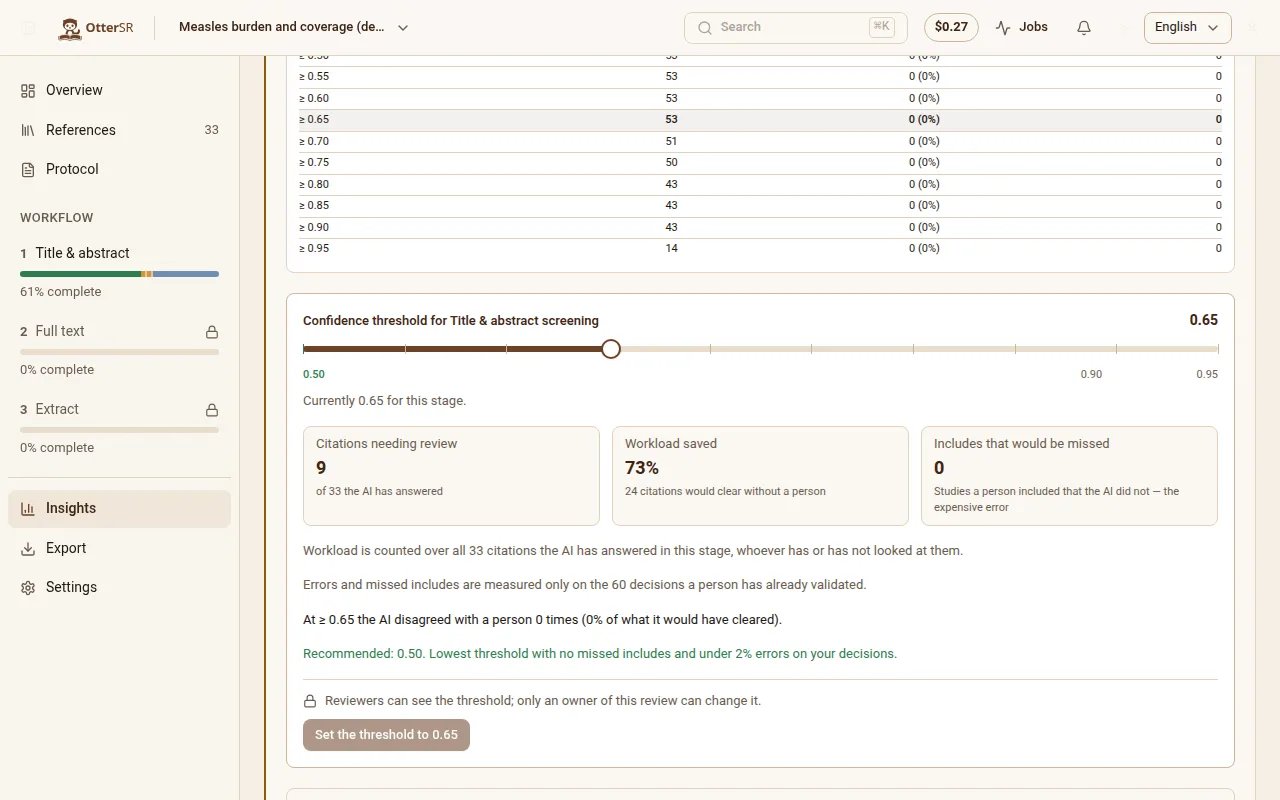
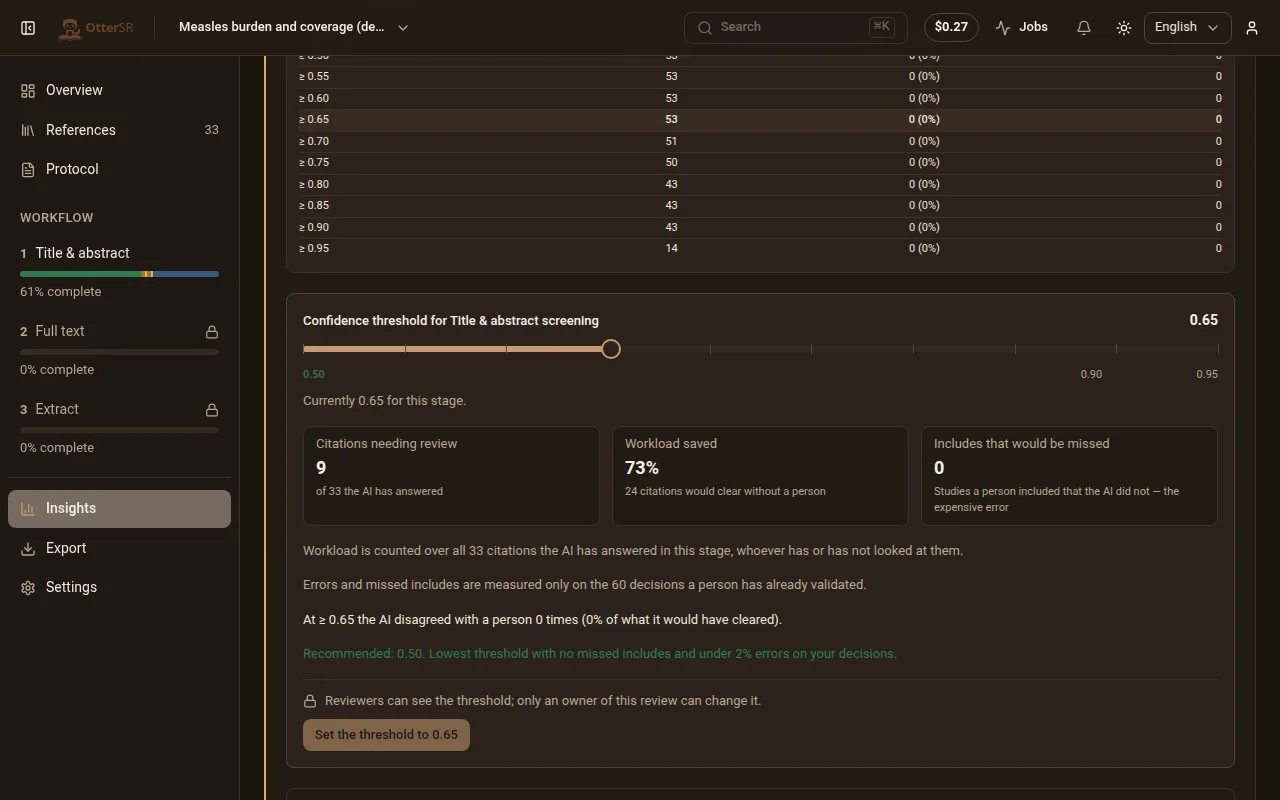
As you validate decisions, OtterSR measures agreement, sensitivity and calibration against your own work. It shows the sample size beside every figure, and says so when the sample is too small for a number. A threshold control shows, at each setting, how much work you’d save and how many includes you’d have missed. The export includes a methods paragraph describing what was done. There’s no subscription. You pay for the AI calls you run, and PDF parsing is charged per page. See pricing and how it works.
Free tools for this step
Related guides
- How to screen titles and abstracts for a systematic reviewHow to screen titles and abstracts for a systematic review: write criteria as decision rules, calibrate first, screen in pairs and keep the counts PRISMA needs.
- How to design a data extraction formHow to design a data extraction form for a systematic review: which fields to collect, piloting, two extractors, and recording where each value came from.
- How to use OtterSR, step by stepHow to run a systematic review in OtterSR, from sign-up to export: the protocol, references, duplicates, AI-assisted screening, extraction, writing and costs.
Sources
- Flemyng E, Noel-Storr A, Macura B, et al. Position statement on artificial intelligence (AI) use in evidence synthesis across Cochrane, the Campbell Collaboration, JBI, and the Collaboration for Environmental Evidence 2025. JBI Evidence Synthesis 2025;23(11):2162–6. Published simultaneously in the Cochrane Database of Systematic Reviews, Campbell Systematic Reviews and Environmental Evidence. https://pmc.ncbi.nlm.nih.gov/articles/PMC12594113/
- Responsible use of AI in evidence SynthEsis (RAISE): recommendations and guidance. Open Science Framework. https://osf.io/fwaud/
- Lefebvre C, Glanville J, Briscoe S, et al. Chapter 4: Searching for and selecting studies [last updated March 2025]. In: Higgins JP, Thomas J, Chandler J, et al (editors). Cochrane Handbook for Systematic Reviews of Interventions version 6.5.1. Cochrane, 2025. https://www.cochrane.org/authors/handbooks-and-manuals/handbook/current/chapter-04
- Li T, Higgins JP, Deeks JJ. Chapter 5: Collecting data [last updated October 2019]. In: Higgins JP, Thomas J, Chandler J, et al (editors). Cochrane Handbook for Systematic Reviews of Interventions version 6.5. Cochrane, 2024. https://www.cochrane.org/authors/handbooks-and-manuals/handbook/current/chapter-05
- Page MJ, McKenzie JE, Bossuyt PM, et al. The PRISMA 2020 statement: an updated guideline for reporting systematic reviews. BMJ 2021;372:n71. https://doi.org/10.1136/bmj.n71