
How to screen titles and abstracts for a systematic review
Say your searches return 3,000 records once duplicates are removed. You’ll exclude most of them here, from a title and a few lines of abstract, so you need to make those calls consistently and keep the counts your PRISMA flow diagram will ask for.
Updated
In brief
- Turn each eligibility criterion into a question, and decide before you start what each answer means for the record.
- Calibrate on a sample first, and rewrite any rule that two people read differently.
- Screen independently, ideally two people per record, and agree in advance how you’ll settle disagreements.
- If a record might be eligible, keep it. You’ll decide on the full text.
- Log a decision for every record, so the counts in your flow diagram can be checked.
What title and abstract screening is for
At this stage you’re only removing records that are obviously irrelevant. Anything that might be eligible goes on to full-text screening, where the final decision is made. In the typical process the Cochrane Handbook describes, this screen comes straight after merging search results and removing duplicate records, and its advice is that authors “should generally be over-inclusive at this stage”.
You’ll see more records here than at any other stage, so it’s tempting to go fast and decide on instinct. Written decision rules and a calibration round are what get two people, or one person on a Monday and again on a Friday, to the same decision about the same record.
Your eligibility criteria should already be in your protocol. If they aren’t, start with writing eligibility criteria with PICO.
Turn criteria into decision rules
A protocol criterion such as “adults with type 2 diabetes” is clear to the person who wrote it. A screener needs something they can apply to a short abstract that may not mention age at all.
Rewrite each criterion as a question with a fixed set of answers, and decide in advance what each answer means. For a review of exercise programmes for adults with type 2 diabetes, it might look like this:
| Question | Include | Exclude | Not stated |
|---|---|---|---|
| Are the participants adults with type 2 diabetes? | Yes | Children, or type 1 or gestational diabetes | Keep for full text |
| Is the intervention a structured exercise programme? | Yes | Advice only, or no exercise component | Keep for full text |
| Is the comparison usual care or no exercise? | Yes | Only other exercise programmes | Keep for full text |
| Were participants allocated at random? | Yes | Allocation clearly not random | Keep for full text |
Screening questions for an example review. Only a clear “no” excludes.
Are the participants adults with type 2 diabetes?
- Include
- Yes
- Exclude
- Children, or type 1 or gestational diabetes
- Not stated
- Keep for full text
Is the intervention a structured exercise programme?
- Include
- Yes
- Exclude
- Advice only, or no exercise component
- Not stated
- Keep for full text
Is the comparison usual care or no exercise?
- Include
- Yes
- Exclude
- Only other exercise programmes
- Not stated
- Keep for full text
Were participants allocated at random?
- Include
- Yes
- Exclude
- Allocation clearly not random
- Not stated
- Keep for full text
If an abstract doesn’t say how participants were allocated, “not stated” is the right answer. The record goes through to full text and you check there.
Leave outcomes out of the rules unless your protocol makes them an eligibility criterion. They usually aren’t part of the criteria for including studies, as chapter 3 of the Cochrane Handbook notes, and an abstract often mentions only some of the outcomes a study measured.
Put the most decisive question first. One failed criterion is enough to exclude a study, and if you assess criteria in order of importance, as the Handbook suggests, the first “no” becomes the primary reason for exclusion. Then write a line of guidance for each borderline case you can predict, such as conference abstracts, trial protocols, mixed populations, and studies where your condition is only a subgroup.
Calibrate before you start
For a pilot, the Handbook suggests a sample of reports, “say six to eight articles”, including some thought definitely eligible, some definitely not and some doubtful. The pilot refines the criteria and trains the people applying them. It also shows, before anyone screens for real, whether more than one person can apply them consistently.
At title and abstract stage, a calibration round usually works like this:
- Everyone screens the same sample independently, without discussing it.
- Compare the decisions and list every disagreement.
- Work out why each one happened. Usually it’s a rule two people read differently, or a case the guidance doesn’t cover.
- Rewrite the rule or add guidance. If the changes were substantial, screen a fresh sample.
Pitfall: Draw the sample from your own search results
Make sure it contains some likely includes. A sample of obvious excludes will show high agreement and teach you nothing.
Keep every version of the rules, with its date. If a rule changes after screening has started, re-check the records you’ve already screened against the new wording. Protocol changes have to be reported too. PRISMA 2020 item 24c asks authors to describe and explain any amendments to the information given at registration or in the protocol.
Two reviewers, working independently
For Cochrane reviews it’s mandatory to use at least two people working independently to decide whether each study meets the eligibility criteria, and to define in advance how disagreements will be resolved. Title and abstract screening has some leeway. The Cochrane Handbook says duplicate screening is ideal at this stage, but that it’s acceptable for this initial screen to be done by one person. The final decision on each study, made on the full text, must involve two people working independently.
“Independently” means neither person sees the other’s decision until both have made theirs. Screening side by side is a different method, and so is one person checking only the other’s excludes. If that’s what you did, describe it that way.
Most disagreements can be settled by discussion, since often one person simply missed something. If the two of you read a criterion differently, a third person may need to arbitrate, and that’s a sign the rule needs rewording.
A common rule at this stage is to send a record forward if either reviewer would include it. That follows from being over-inclusive. A record wrongly excluded here is gone for good, while one wrongly kept costs one full-text read. Whichever rule you choose, write it into the protocol before you start.
What to report: If you can’t screen everything twice, say so
PRISMA 2020 item 8 asks you to report how many reviewers screened each record and each report retrieved, and whether they worked independently.
Measure agreement
Agreement statistics tell you whether people are applying your rules the same way. Two are common:
- Percentage agreement is the share of records on which both reviewers made the same decision. It’s easy to compute, but it looks high whenever most records are clear excludes.
- Cohen’s kappa compares the agreement you observed with the agreement you’d expect by chance, given how often each reviewer says include. A kappa of 1 is perfect agreement, and 0 is no better than chance.
Includes are rare at this stage, so look at the disagreements on them directly. Two reviewers can agree on almost every record and still disagree about many of the ones that matter.
| B includes | B excludes | |
|---|---|---|
| A includes | 6 | 4 |
| A excludes | 3 | 187 |
Example: Kappa for this hypothetical sample
The reviewers agree on 6 + 187 = 193 records, so percentage agreement is 193 ÷ 200 = 96.5%.
A includes 10 of the 200 (0.05) and B includes 9 (0.045). Agreement expected by chance is 0.05 × 0.045 + 0.95 × 0.955 = 0.9095.
Kappa is (0.965 − 0.9095) ÷ (1 − 0.9095) = 0.0555 ÷ 0.0905 = 0.61. Of the 13 records either reviewer included, they agreed on only 6.
The Handbook’s chapter on collecting data mentions kappa as one way to quantify agreement between people extracting data, and notes that this isn’t routinely done in Cochrane reviews. Before you calibrate, agree what level you’ll accept on the sample and what you’ll do if you fall short, which is usually another round of calibration. Report the measure with the number of records behind it, and say when you took it.
Record every decision
The Handbook expects the selection process to be documented in enough detail to complete a flow diagram and a table of excluded studies. For exclusions at title and abstract stage, numbers of records are sufficient, so you don’t have to give a reason for each one.
For each record, keep:
- each reviewer’s decision, made before they saw the other’s;
- the final decision, and who resolved it if they disagreed;
- the version of the rules in force at the time;
- a note on why a borderline record was kept.
Don’t delete duplicates from your library without counting them. They appear in the flow diagram as records removed before screening (see the PRISMA 2020 flow diagram, explained).
If software prioritised records or proposed decisions, PRISMA 2020 item 8 also asks for details of the automation tools used. Using AI in systematic reviews responsibly covers what to check and what to report.
Doing this in OtterSR
In OtterSR, each eligibility question has answer options tagged include, exclude or neutral, so every answer has a defined meaning. The AI proposes an answer to each question, with its confidence and the sentence it was drawn from, and you accept it or choose another. A second opinion is on by default: a critic agent re-reads each AI answer and flags the ones it disagrees with for a person. It doesn’t replace a second human reviewer where your protocol calls for one.
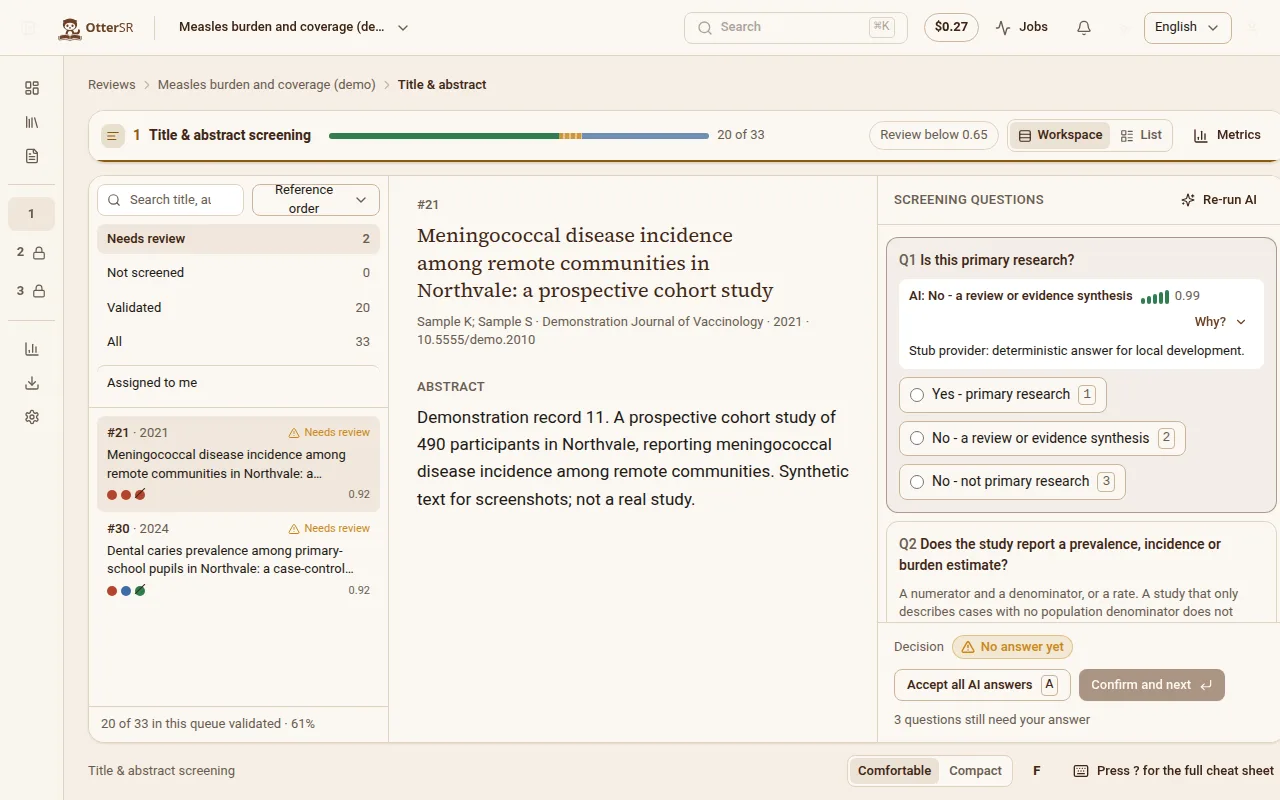
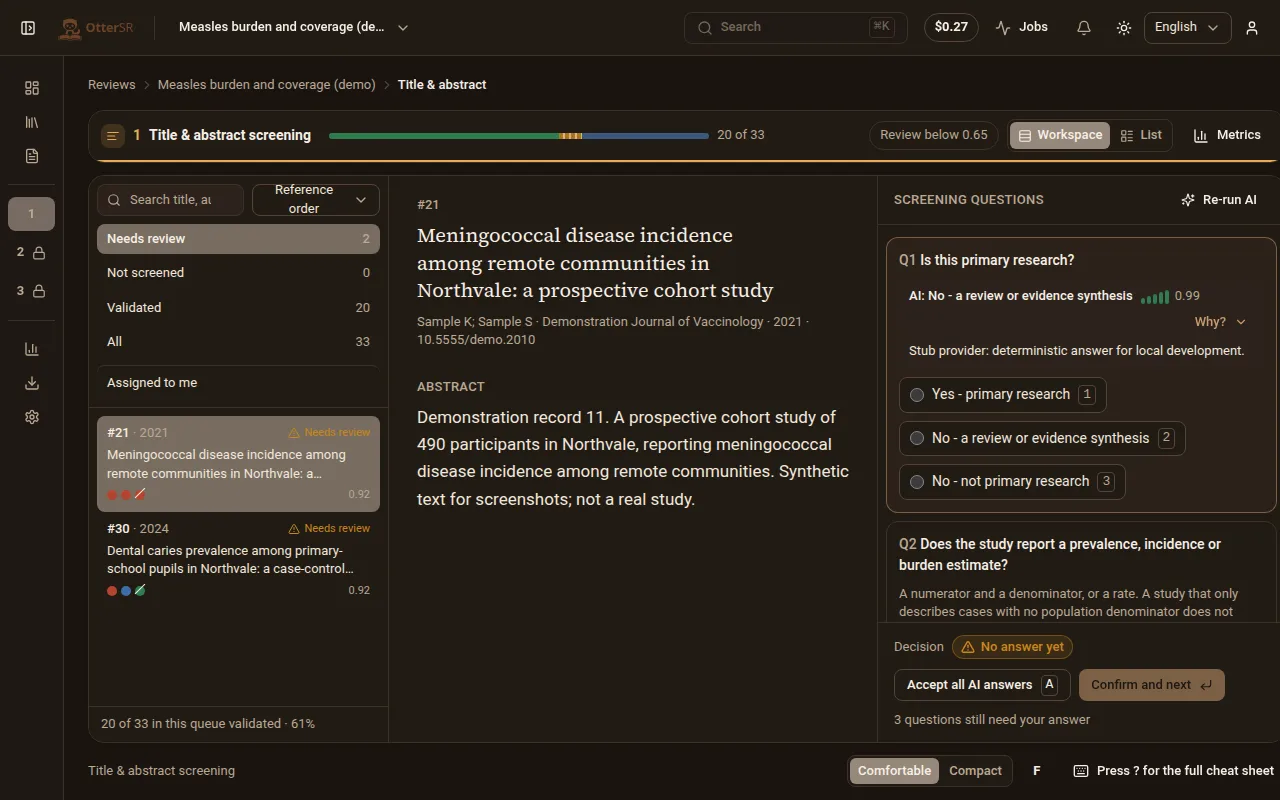
As you validate decisions, OtterSR measures agreement with your own work and shows the sample size beside each figure. Duplicate removal is a soft delete, so removed duplicates still count in the PRISMA flow. There’s no subscription. You pay for the AI calls you run, and PDF parsing is charged per page. See how it works and pricing.
Free tools for this step
- Cohen’s kappa calculator, step by stepUse this when two or more people have screened or coded the same records and you need their agreement beyond chance.
- Duplicate reference finderUse this when you’ve merged search results from several databases and need the duplicates out before screening, with a count for PRISMA.
Related guides
- How to remove duplicate references in EndNote, Zotero, Mendeley and OtterSRHow EndNote, Zotero and Mendeley find duplicate references, what each misses, how to resolve them safely, and how to count duplicates removed for PRISMA 2020.
- Full-text screening and recording reasons for exclusionHow to run full-text screening for a systematic review: getting the reports, linking them to studies, applying the criteria and giving one reason per exclusion.
- Using AI in systematic reviews responsiblyWhere AI helps in a systematic review, why a person must check its output, how to validate it on a sample, and what to report and agree with your supervisor.
Sources
- Lefebvre C, Glanville J, Briscoe S, et al. Chapter 4: Searching for and selecting studies [last updated March 2025]. In: Higgins JP, Thomas J, Chandler J, et al (editors). Cochrane Handbook for Systematic Reviews of Interventions version 6.5.1. Cochrane, 2025. https://www.cochrane.org/authors/handbooks-and-manuals/handbook/current/chapter-04
- McKenzie JE, Brennan SE, Ryan RE, Thomson HJ, Johnston RV, Thomas J. Chapter 3: Defining the criteria for including studies and how they will be grouped for the synthesis [last updated August 2023]. In: Higgins JP, Thomas J, Chandler J, et al (editors). Cochrane Handbook for Systematic Reviews of Interventions version 6.5. Cochrane, 2024. https://www.cochrane.org/authors/handbooks-and-manuals/handbook/current/chapter-03
- Li T, Higgins JP, Deeks JJ. Chapter 5: Collecting data [last updated October 2019]. In: Higgins JP, Thomas J, Chandler J, et al (editors). Cochrane Handbook for Systematic Reviews of Interventions version 6.5. Cochrane, 2024. https://www.cochrane.org/authors/handbooks-and-manuals/handbook/current/chapter-05
- Page MJ, McKenzie JE, Bossuyt PM, et al. The PRISMA 2020 statement: an updated guideline for reporting systematic reviews. BMJ 2021;372:n71. https://doi.org/10.1136/bmj.n71