
Writing eligibility criteria with PICO
You’ve got a review question. Before anyone can screen, you need rules that say which studies are in, and PICO is the usual way to get from one to the other. For some questions a variant such as PECO or SPIDER fits better.
Updated
In brief
- Write the question first. Each PICO element then becomes a criterion.
- Specify study design by its features, whatever label the authors give it.
- In a review of intervention effects, outcomes usually aren’t eligibility criteria.
- Use PECO for exposures, and consider SPIDER for qualitative questions.
- Fix the criteria in your protocol before screening, and record any change.
From question to criteria
PICO stands for population, intervention, comparator and outcome. According to the Cochrane Handbook, eligibility criteria are based on the PICO elements of the review question plus a specification of the types of studies that have addressed it. The population, interventions and comparators usually translate directly into criteria.
Start with a question you could state in one sentence, such as “In adults with type 2 diabetes, do structured exercise programmes, compared with usual care, improve glycaemic control?” Then take each element in turn and decide what must be true for a study to be included, and what you’ll do with the cases at the edge.
“In adults with type 2 diabetesP, do structured exercise programmesI, compared with usual careC, improve glycaemic controlO?”
- PPopulationAdults with type 2 diabetesUsually becomes a criterion
- IInterventionStructured exercise programmesUsually becomes a criterion
- CComparatorUsual careUsually becomes a criterion
- OOutcomeGlycaemic controlUsually not a criterion
Writing a criterion for each element
Population
Make the participant criteria broad enough to cover the likely diversity of studies and the likely scenarios in which the intervention will be used, but narrow enough that a meaningful answer can be obtained when the studies are considered together. Think about the setting, how the condition is diagnosed or defined, and demographic factors such as age. The Handbook says any restriction needs a sound rationale.
Tip: Mixed populations
Decide now what to do with studies where only some participants meet your criteria, such as a trial that recruited adults with either type 1 or type 2 diabetes. One option is to include it only if results are reported separately for the eligible group. Whatever you choose, write it down.
Intervention and comparator
Define the intervention precisely enough that two people would agree on whether a study tested it. Any restrictions on delivery, dose, duration, intensity and co-interventions should be set out in advance, with your reasons. For the comparator, say whether you mean an inactive control, such as placebo, no treatment, standard care or a waiting list, or an active one, such as a different variant of the intervention, a different drug or another kind of therapy.
Outcomes
In a review of intervention effects, outcomes usually aren’t part of the criteria for including studies. The Handbook describes a Cochrane review as typically seeking all sufficiently rigorous studies of a comparison in a population, irrespective of the outcomes measured or reported. Some reviews do legitimately restrict eligibility to specific outcomes. If yours does, say why.
Tip: You still list the outcomes in your protocol
They define what you’ll extract and analyse. They just don’t decide which studies get in.
Study design
Adding study design to PICO gives PICOS. The Handbook says eligibility should be based on explicit study design features, not on the labels primary researchers apply, such as “case-control” or “cohort”, which are often used inconsistently. A screener can test “participants were allocated to groups at random” against a report. The words “randomised controlled trial” in a title aren’t enough on their own.
Publication status and language
Think hard before restricting either. The Handbook says there would need to be a compelling argument for excluding studies on the basis of publication status, and that restricting eligible studies to one language, usually English, has implications for bias and equity that should be considered carefully.
A worked example in type 2 diabetes
Written out as rules, the diabetes and exercise question could look like this. The specific choices are only illustrations, and yours will depend on your question.
| Element | Include | Exclude |
|---|---|---|
| Population | Adults aged 18 or over with type 2 diabetes, in any setting. | Type 1 or gestational diabetes. Mixed populations, unless results for adults with type 2 diabetes are reported separately. |
| Intervention | A structured exercise programme lasting at least eight weeks. | Advice about exercise with no programme. Exercise as one part of a wider lifestyle intervention. |
| Comparator | Usual care, or no exercise programme. | Comparisons only against another exercise programme. |
| Outcomes | Not a criterion. HbA1c is the planned primary outcome. | Do not exclude a study for not reporting HbA1c. |
| Study design | Participants allocated to groups at random, including cluster-randomised trials. | Allocation by alternation, date of birth or another method that is not random. |
Eligibility rules for an example review of exercise programmes in type 2 diabetes.
Population
- Include
- Adults aged 18 or over with type 2 diabetes, in any setting.
- Exclude
- Type 1 or gestational diabetes. Mixed populations, unless results for adults with type 2 diabetes are reported separately.
Intervention
- Include
- A structured exercise programme lasting at least eight weeks.
- Exclude
- Advice about exercise with no programme. Exercise as one part of a wider lifestyle intervention.
Comparator
- Include
- Usual care, or no exercise programme.
- Exclude
- Comparisons only against another exercise programme.
Outcomes
- Include
- Not a criterion. HbA1c is the planned primary outcome.
- Exclude
- Do not exclude a study for not reporting HbA1c.
Study design
- Include
- Participants allocated to groups at random, including cluster-randomised trials.
- Exclude
- Allocation by alternation, date of birth or another method that is not random.
Each exclude rule either mirrors an include rule or settles an edge case. If an exclude rule adds a new requirement, it’s really another criterion, so move it into the include column where everyone will see it.
When to use PICOS, PECO or SPIDER
PICO fits questions about the effects of interventions best, and other kinds of question have their own frameworks. Use whichever one makes your criteria complete and testable.
- PICOS adds study design. Most reviews specify design anyway, so the S mainly makes it explicit.
- PECO replaces the intervention with an exposure. It’s for questions where nobody assigns the exposure, such as environmental, occupational or lifestyle risks.
- SPIDER stands for sample, phenomenon of interest, design, evaluation and research type. Cooke, Smith and Booth proposed it in 2012 as an alternative to PICO for searching for qualitative and mixed-methods research, and called for it to be refined and tested further. You can also use its elements to structure eligibility criteria.
An exposure example, with PECO
Question: “Is long-term exposure to road traffic noise at home associated with high blood pressure in adults?”
- Population: adults in the general population.
- Exposure: road traffic noise at the home address, measured or modelled.
- Comparator: people with lower levels of the same exposure.
- Outcome: hypertension, defined by measured blood pressure, diagnosis or treatment. Here the outcome is the question itself, so it’s a criterion.
- Study design: studies comparing people with different levels of exposure, judged by their design features and not their label.
A qualitative example, with SPIDER
Question: “How do adults with type 2 diabetes experience structured exercise programmes?”
- Sample: adults with type 2 diabetes who have taken part in a structured exercise programme.
- Phenomenon of interest: their experience of taking part, including what helped and what got in the way.
- Design: interviews, focus groups or other qualitative data collection.
- Evaluation: views, experiences and perceptions.
- Research type: qualitative studies, and mixed-methods studies that report their qualitative findings separately.
Fix the criteria in advance
The Handbook says decisions about the criteria, and about how studies will be grouped, should be made independent of knowing which studies will be included. Changes to the protocol must not be made on the basis of the findings of the studies or the synthesis, as this can introduce bias. Changes are sometimes needed, though, for example when an important variation in the intervention only becomes apparent once data are collected. Justify them and document them in the review.
Registering your protocol makes all this visible. PROSPERO, developed and managed by the Centre for Reviews and Dissemination at the University of York, registers systematic reviews that have a health-related outcome. Its guidance for registering human studies says a full protocol should be ready before you register, and that submissions must be made before data extraction starts. PRISMA 2020 item 24 asks you to report the registration and protocol, and to describe and explain any amendments.
Before screening starts, test the criteria on a handful of real reports and fix whatever people read differently. The guide to title and abstract screening covers how to calibrate.
Doing this in OtterSR
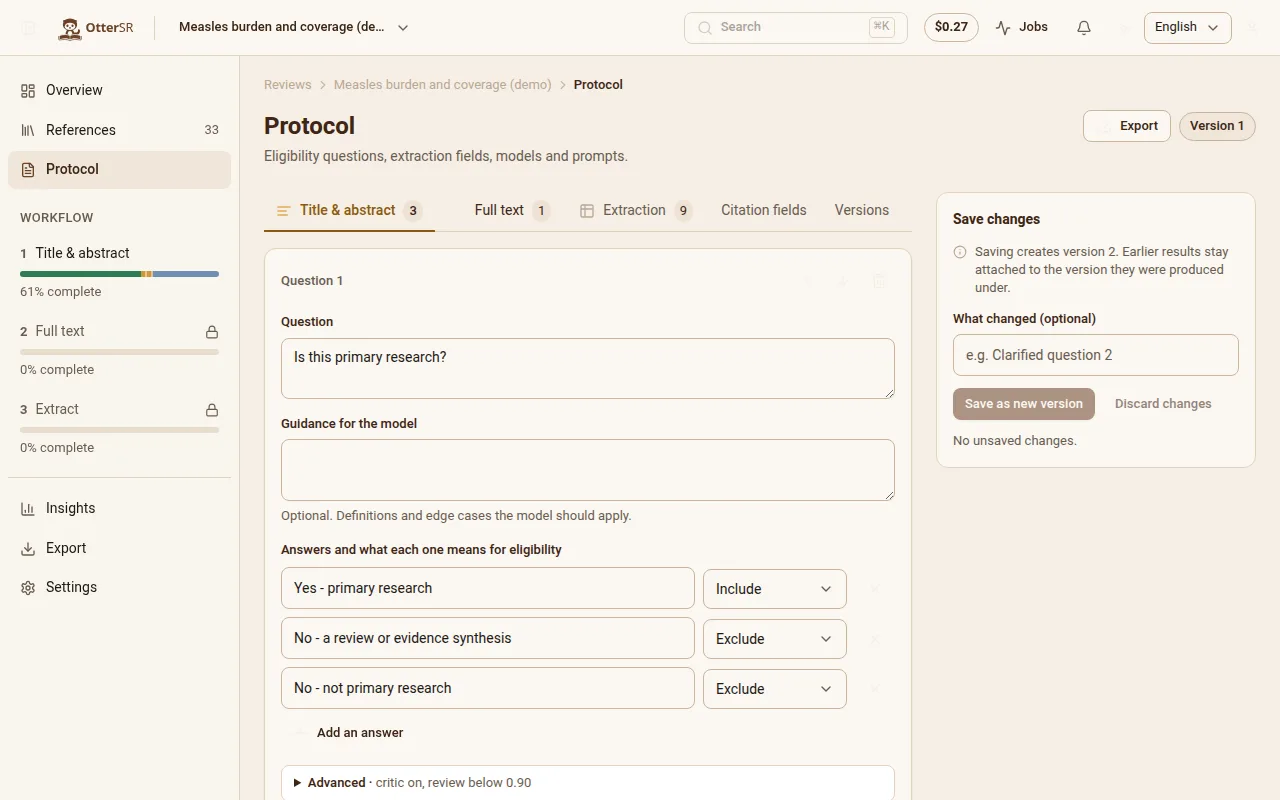
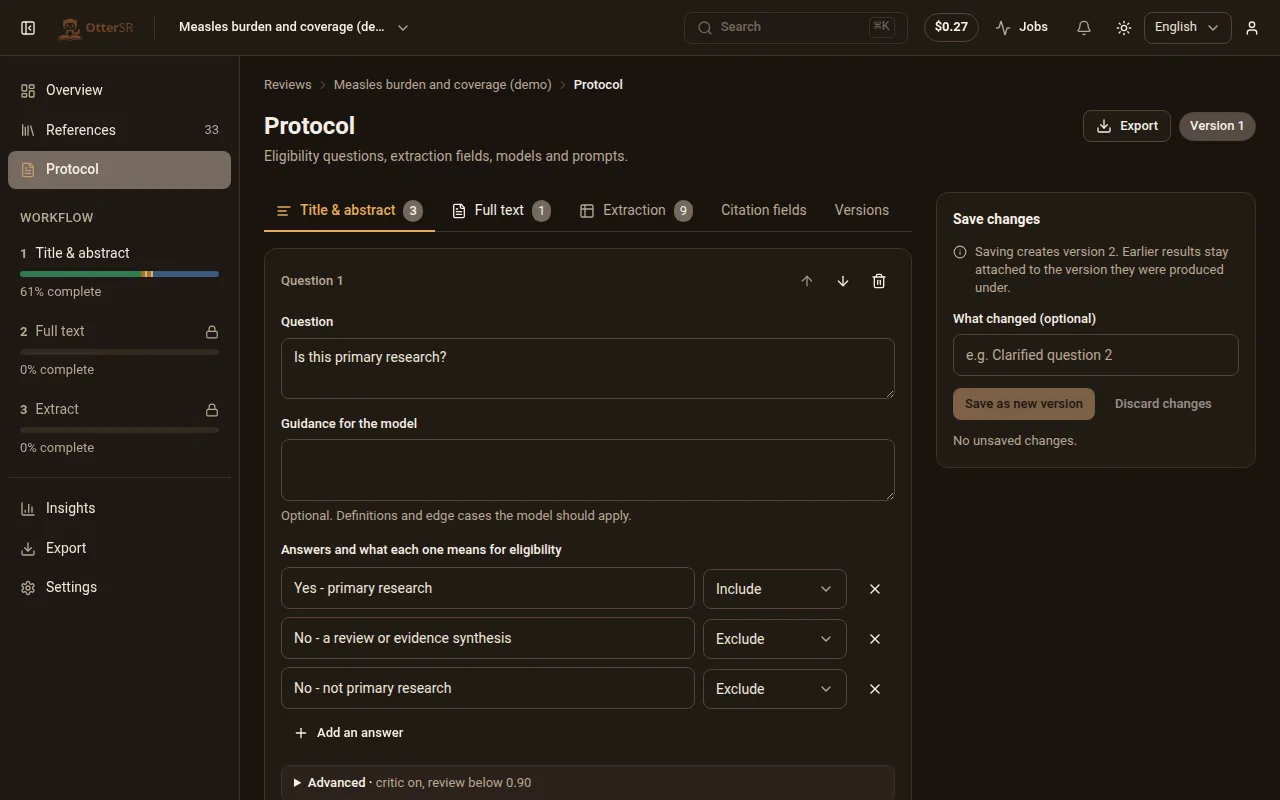
In OtterSR’s protocol editor, each eligibility question gets its answer options, and each option is tagged include, exclude or neutral. The software knows what an answer means from its tag, without guessing from the wording. You add guidance in your own words for the borderline cases. Protocols are versioned, so changing one creates a new version and never silently rewrites decisions already made. You can start from a template, import a colleague’s protocol file or write your own. See how it works.
Free tools for this step
Related guides
- How to write a systematic review protocol and register itHow to write a systematic review protocol with PRISMA-P, register it on PROSPERO or OSF, handle amendments and report it all under PRISMA 2020 item 24.
- How to build a systematic review search strategyHow to build a systematic review search strategy: concept blocks, MeSH and free-text terms, Boolean operators, filters, grey literature, PRESS and PRISMA-S.
- How to screen titles and abstracts for a systematic reviewHow to screen titles and abstracts for a systematic review: write criteria as decision rules, calibrate first, screen in pairs and keep the counts PRISMA needs.
Sources
- McKenzie JE, Brennan SE, Ryan RE, Thomson HJ, Johnston RV, Thomas J. Chapter 3: Defining the criteria for including studies and how they will be grouped for the synthesis [last updated August 2023]. In: Higgins JP, Thomas J, Chandler J, et al (editors). Cochrane Handbook for Systematic Reviews of Interventions version 6.5. Cochrane, 2024. https://www.cochrane.org/authors/handbooks-and-manuals/handbook/current/chapter-03
- Cooke A, Smith D, Booth A. Beyond PICO: the SPIDER tool for qualitative evidence synthesis. Qualitative Health Research 2012;22(10):1435–43. https://doi.org/10.1177/1049732312452938
- PROSPERO, International prospective register of systematic reviews. Guidance for registering human studies. Centre for Reviews and Dissemination, University of York. https://www.crd.york.ac.uk/prospero/documents/Guidance%20for%20registering%20human%20studies.pdf
- Page MJ, McKenzie JE, Bossuyt PM, et al. The PRISMA 2020 statement: an updated guideline for reporting systematic reviews. BMJ 2021;372:n71. https://doi.org/10.1136/bmj.n71