
How to write a systematic review protocol and register it
You know your question and you’re about to start searching. First, write down how you’ll do the review and put a dated copy where anyone can see it. That’s the protocol and its registration, and PROSPERO won’t take a registration once data extraction has started.
Updated
In brief
- A protocol is the plan for your review, written before you start. PRISMA-P 2015 lists 17 items it should cover.
- Register before screening if you can. PROSPERO won’t accept a review that has started data extraction.
- PROSPERO doesn’t take scoping reviews. Register those on OSF or another platform.
- A registry record isn’t the whole protocol. Share the full protocol too.
- Changes are normal. Date and explain each one, update the record, and report it under PRISMA 2020 item 24c.
What a systematic review protocol is for
PRISMA-P defines a protocol as “a document that presents an explicit plan for a systematic review”, and says what you plan should be “explicitly documented before the review starts”. The companion paper by Shamseer and colleagues gives four reasons to write one:
- it makes you plan carefully and anticipate problems;
- it records your plan before you start, so others can compare it with the finished review and spot selective reporting;
- it prevents arbitrary decisions about inclusion criteria and data extraction;
- once public, it can reduce duplicated effort.
The Cochrane Handbook adds that a protocol written without knowledge of the available studies reduces the impact of the authors’ biases. PRISMA-P is aimed mainly at reviews of aggregate data, such as intervention effects, and its authors encourage using it for other types where it applies.
How to write a systematic review protocol with PRISMA-P
PRISMA-P has 17 numbered items, 26 counting sub-items. Items 1 to 5 are administrative, 6 and 7 are the introduction, and 8 to 17 are the methods. Shamseer and colleagues say you can change the order, as long as each item appears somewhere. For a hypothetical review of exercise programmes in type 2 diabetes, an outline could look like this:
| PRISMA-P item | What to write | Example line |
|---|---|---|
| Title (1a, 1b) | Identify it as a systematic review protocol, and as an update if it is one. | “Exercise programmes in type 2 diabetes: protocol for a systematic review.” |
| Registration (2) | The registry’s name and registration number. | “Registered in PROSPERO (number to follow).” |
| Authors (3a, 3b) | Contact details, each author’s contribution, the guarantor. | “AB is the guarantor. CD designed the search.” |
| Amendments (4) | Changes from an earlier protocol, or how you’ll record amendments. | “Each amendment will be dated, described and justified.” |
| Support (5a to 5c) | Funding, the funder or sponsor, and their role. | “The funder had no role in this protocol.” |
| Rationale (6) | Why the review is needed, given what’s known. | “We found no review comparing supervised with unsupervised programmes.” |
| Objectives (7) | The question, stated explicitly with its PICO elements. | “Do exercise programmes improve HbA1c compared with usual care?” |
| Eligibility criteria (8) | Study and report characteristics that make a study eligible, with reasons. See writing eligibility criteria with PICO. | “Randomised trials in adults, any setting, any language.” |
| Information sources (9) | Every source you’ll search, with dates of coverage. | “MEDLINE, Embase and CENTRAL from inception.” |
| Search strategy (10) | A draft search for at least one database, with limits. See building a search strategy. | “The draft MEDLINE strategy is in appendix 1.” |
| Study records (11a to 11c) | How you’ll manage records, select studies and extract data. | “Two reviewers will screen each record independently.” |
| Data items (12) | Every variable you’ll collect, defined. | “Programme type, duration, supervision.” |
| Outcomes and prioritisation (13) | Each outcome, defined, and which are main or additional. | “The primary outcome is change in HbA1c.” |
| Risk of bias in individual studies (14) | The method, at study or outcome level, and how you’ll use it. See choosing a risk of bias tool. | “Two reviewers will assess each trial with RoB 2.” |
| Data synthesis (15a to 15d) | When and how you’ll pool, extra analyses, and the summary if you can’t pool. | “Similar trials will be pooled in a random-effects model.” |
| Meta-bias(es) (16) | Planned checks for publication bias or selective reporting. | “We will compare registered with published outcomes.” |
| Confidence in cumulative evidence (17) | How you’ll judge the body of evidence, such as with GRADE. | “We will rate certainty for each outcome with GRADE.” |
A protocol outline following the PRISMA-P 2015 items, paraphrased, with example lines for a hypothetical review.
Title (1a, 1b)
- What to write
- Identify it as a systematic review protocol, and as an update if it is one.
- Example line
- “Exercise programmes in type 2 diabetes: protocol for a systematic review.”
Registration (2)
- What to write
- The registry’s name and registration number.
- Example line
- “Registered in PROSPERO (number to follow).”
Authors (3a, 3b)
- What to write
- Contact details, each author’s contribution, the guarantor.
- Example line
- “AB is the guarantor. CD designed the search.”
Amendments (4)
- What to write
- Changes from an earlier protocol, or how you’ll record amendments.
- Example line
- “Each amendment will be dated, described and justified.”
Support (5a to 5c)
- What to write
- Funding, the funder or sponsor, and their role.
- Example line
- “The funder had no role in this protocol.”
Rationale (6)
- What to write
- Why the review is needed, given what’s known.
- Example line
- “We found no review comparing supervised with unsupervised programmes.”
Objectives (7)
- What to write
- The question, stated explicitly with its PICO elements.
- Example line
- “Do exercise programmes improve HbA1c compared with usual care?”
Eligibility criteria (8)
- What to write
- Study and report characteristics that make a study eligible, with reasons. See writing eligibility criteria with PICO.
- Example line
- “Randomised trials in adults, any setting, any language.”
Information sources (9)
- What to write
- Every source you’ll search, with dates of coverage.
- Example line
- “MEDLINE, Embase and CENTRAL from inception.”
Search strategy (10)
- What to write
- A draft search for at least one database, with limits. See building a search strategy.
- Example line
- “The draft MEDLINE strategy is in appendix 1.”
Study records (11a to 11c)
- What to write
- How you’ll manage records, select studies and extract data.
- Example line
- “Two reviewers will screen each record independently.”
Data items (12)
- What to write
- Every variable you’ll collect, defined.
- Example line
- “Programme type, duration, supervision.”
Outcomes and prioritisation (13)
- What to write
- Each outcome, defined, and which are main or additional.
- Example line
- “The primary outcome is change in HbA1c.”
Risk of bias in individual studies (14)
- What to write
- The method, at study or outcome level, and how you’ll use it. See choosing a risk of bias tool.
- Example line
- “Two reviewers will assess each trial with RoB 2.”
Data synthesis (15a to 15d)
- What to write
- When and how you’ll pool, extra analyses, and the summary if you can’t pool.
- Example line
- “Similar trials will be pooled in a random-effects model.”
Meta-bias(es) (16)
- What to write
- Planned checks for publication bias or selective reporting.
- Example line
- “We will compare registered with published outcomes.”
Confidence in cumulative evidence (17)
- What to write
- How you’ll judge the body of evidence, such as with GRADE.
- Example line
- “We will rate certainty for each outcome with GRADE.”
For a template, use the checklist items as your headings. For examples, Shamseer and colleagues give a model passage from a published protocol for every item, and the Cochrane Handbook notes that all Cochrane protocols are published in the Cochrane Database of Systematic Reviews.
Where to register: PROSPERO, OSF and others
Which registry you use depends on your review type.
| Registry | What it registers | Cost | What you get |
|---|---|---|---|
| PROSPERO | Systematic reviews with outcomes of direct relevance to human health. Not scoping reviews. | Free | A public record with a CRD number. Every version stays visible. |
| OSF Registries | Any study, with a template for systematic reviews, scoping reviews and meta-analyses. | Free | A time-stamped, read-only registration, with a DOI once public. |
| INPLASY | Systematic review, scoping review and methodological study protocols. | A fee per protocol, unless you’re a member | A published protocol with a DOI and an INPLASY number. |
Three places to register a review protocol.
PROSPERO
- What it registers
- Systematic reviews with outcomes of direct relevance to human health. Not scoping reviews.
- Cost
- Free
- What you get
- A public record with a CRD number. Every version stays visible.
OSF Registries
- What it registers
- Any study, with a template for systematic reviews, scoping reviews and meta-analyses.
- Cost
- Free
- What you get
- A time-stamped, read-only registration, with a DOI once public.
- What it registers
- Systematic review, scoping review and methodological study protocols.
- Cost
- A fee per protocol, unless you’re a member
- What you get
- A published protocol with a DOI and an INPLASY number.
What PROSPERO accepts
PROSPERO only accepts systematic reviews examining outcomes of direct relevance to human health and wellbeing, with a separate section for animal studies. It doesn’t register scoping reviews (though it says they may be added in future), literature reviews that use only a systematic search, reviews of in-vitro studies only, or reviews with sports performance as the outcome. It doesn’t publish records made for training or course assignments. Registration is free, according to its guidance for registering human studies.
The PROSPERO registration form and number
You need an ORCID to create a record. The form asks for the main elements of your protocol in English, and you must fill in every field even if you upload the full protocol. The record is published once every named author has approved it. A PROSPERO record doesn’t hold everything a protocol should, Shamseer and colleagues point out, so keep the full protocol available too.
Registration numbers start with CRD, as in CRD42011001410, the example in the PRISMA-P explanation paper. Report yours in the protocol and in every publication from the review.
Pitfall: Registering a finished review
PROSPERO says you must not create a registration for a completed review, even if a journal asks for a registration number. If you missed the window, PRISMA 2020 item 24a lets you state that the review wasn’t registered, and you can explain why in your methods.
When to register your protocol
Register once the protocol is finished, or very nearly, and before screening if you can. Shamseer and colleagues describe registration as recording the review’s features “when the protocol has been finalized but before any eligibility screening has started”.
PROSPERO’s hard limit comes later. A review must be registered before data extraction starts, or before individual participant data are received. Don’t register too early either. PROSPERO asks you to have the resources to finish first, such as a funding award or a firm commitment of the authors’ time.
Scoping review protocol registration on OSF
Since PROSPERO doesn’t take scoping reviews, the JBI Manual points to other platforms, such as OSF. OSF’s generalised systematic review template is for preregistering systematic reviews, scoping reviews and meta-analyses.
An OSF registration is a time-stamped, read-only copy of your plan. A public one automatically gets a DOI, which OSF treats as its registration number, and you can embargo a registration for up to four years. In the finished review, PRISMA-ScR item 5 asks whether a protocol exists, where it can be accessed and what the registration number is.
How to handle protocol amendments
Shamseer and colleagues call protocols “typically iterative documents” and expect changes before and during the review. Timing matters, because changing outcomes after you know the included studies’ findings can introduce bias. The Cochrane Handbook says changes to the methods should be transparently declared.
Give an updated protocol a new version number and a list of the changes from the previous version, as Shamseer and colleagues suggest. Add the details and reasons to the registration record, and report them in the final review.
In PROSPERO, a minor amendment covers only a few fields. Changes to the methods or the team need a major revision, which every author must approve before it’s published as a new version. On OSF, an update needs a written justification, and OSF says updates should only reflect events outside your control or unexpected anomalies.
Tip: Keep an amendments log
Keep one row per change, with the date, the protocol section, what it said before and after, the reason, and whether anyone had seen the included studies’ results by then. Copy each change into the registry record as you make it, so the two always match. At the end, it gives you what PRISMA 2020 item 24c asks for.
Reporting registration and amendments
What to report: What PRISMA 2020 asks for in item 24
PRISMA 2020 item 24a asks for the register name and registration number, or a statement that the review wasn’t registered. Item 24b asks where the protocol can be accessed, or a statement that no protocol was prepared. Item 24c asks you to describe and explain any amendments to the information provided at registration or in the protocol.
Your abstract needs the register name and number too, under item 12 of PRISMA 2020 for Abstracts.
Doing this in OtterSR
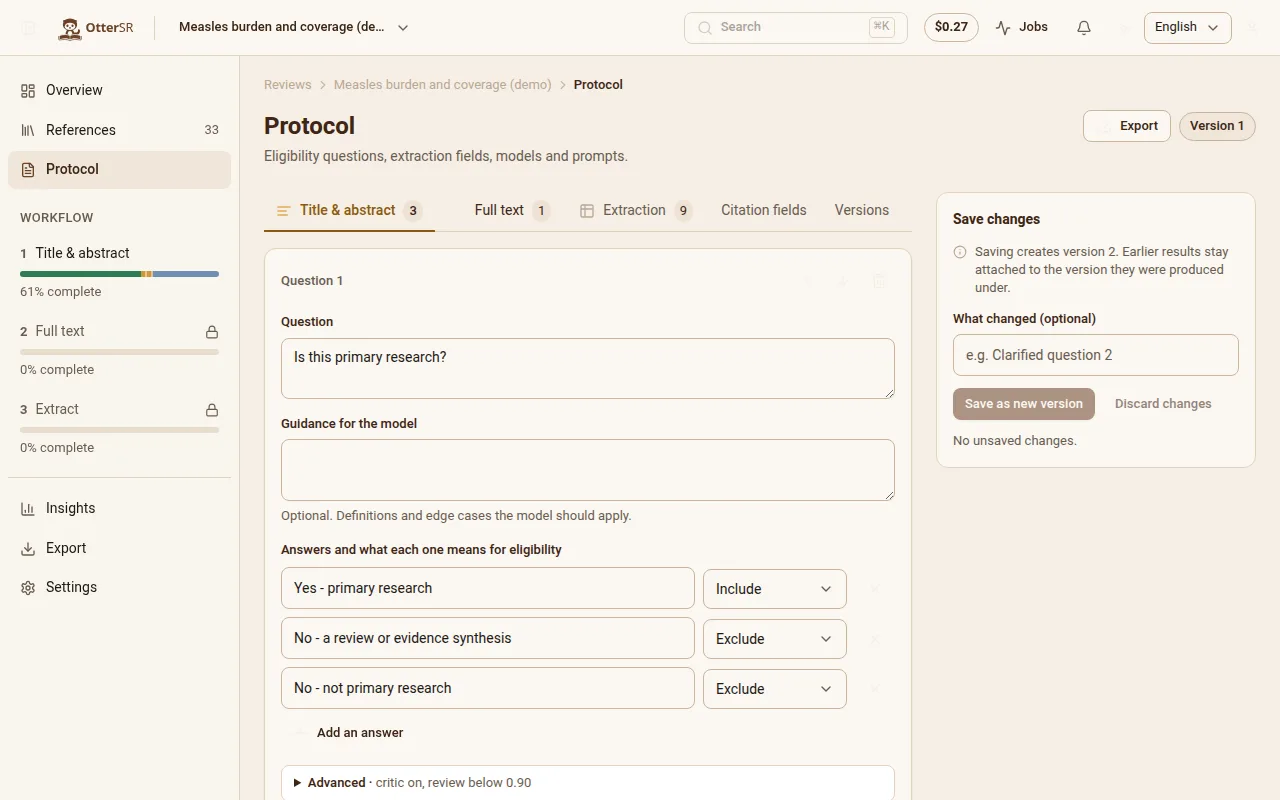
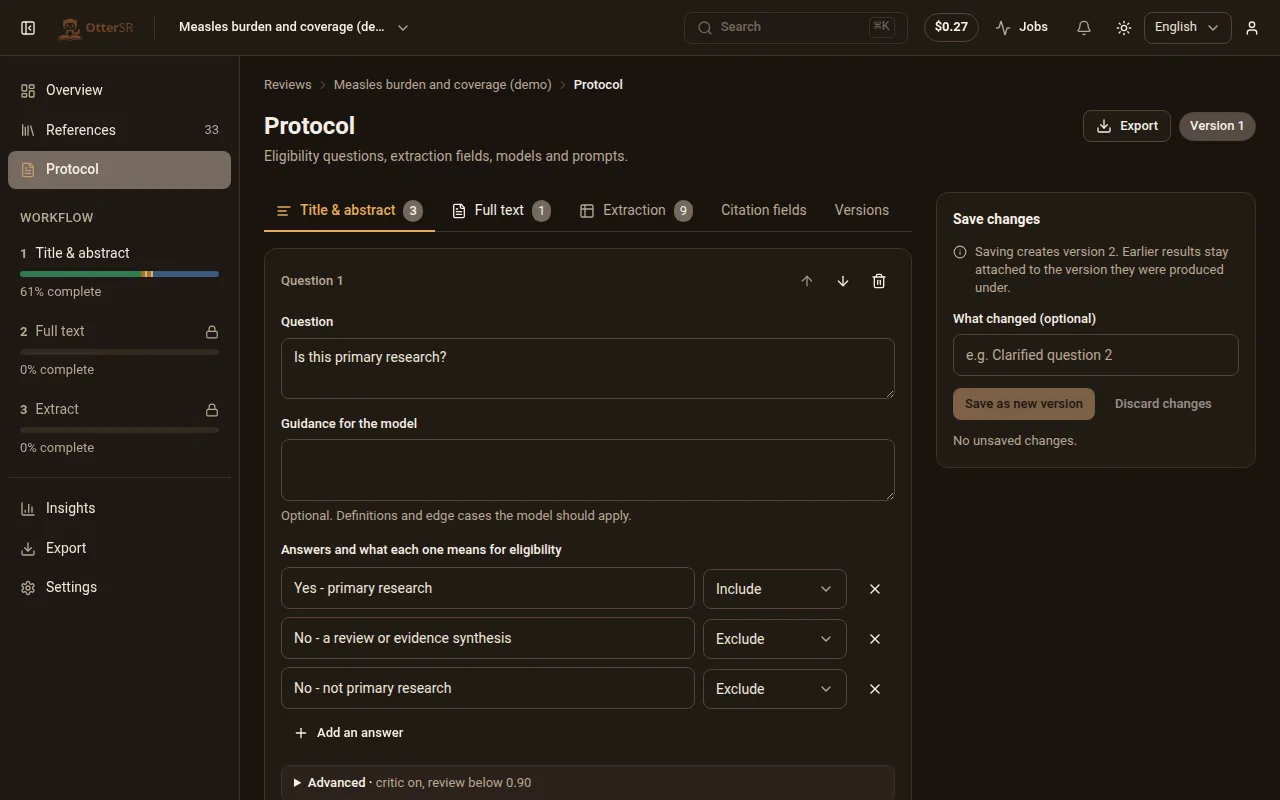
OtterSR doesn’t write or register your protocol. Its protocol page holds the parts screening and extraction run on, which are eligibility questions with answers tagged include, exclude or neutral, and the fields to extract. You can paste in a protocol you already have, such as your PROSPERO record, and have the AI draft those questions and fields as a new version for you to check.
Each saved change creates a new version with an optional note on what changed, and earlier results stay attached to the version they were produced under. You can export the protocol as a YAML file to publish beside your paper. See how it works.
Free tools for this step
Related guides
- How to register a systematic review on PROSPERO, OSF or INPLASYWhere and when to register a systematic review: PROSPERO’s 2025 rules, OSF and INPLASY compared, what each form asks for, and how to amend a registration.
- Writing eligibility criteria with PICOHow to turn a review question into eligibility criteria with PICO, when to use PICOS, PECO or SPIDER instead, and worked include and exclude rules to adapt.
- How to build a systematic review search strategyHow to build a systematic review search strategy: concept blocks, MeSH and free-text terms, Boolean operators, filters, grey literature, PRESS and PRISMA-S.
Sources
- Moher D, Shamseer L, Clarke M, et al. Preferred reporting items for systematic review and meta-analysis protocols (PRISMA-P) 2015 statement. Systematic Reviews 2015;4:1. https://doi.org/10.1186/2046-4053-4-1
- Shamseer L, Moher D, Clarke M, et al. Preferred reporting items for systematic review and meta-analysis protocols (PRISMA-P) 2015: elaboration and explanation. BMJ 2015;349:g7647. https://doi.org/10.1136/bmj.g7647
- Lasserson TJ, Thomas J, Higgins JP. Chapter 1: Starting a review [last updated August 2021]. In: Higgins JP, Thomas J, Chandler J, et al (editors). Cochrane Handbook for Systematic Reviews of Interventions version 6.5. Cochrane, 2024. https://www.cochrane.org/authors/handbooks-and-manuals/handbook/current/chapter-01
- INPLASY, International Platform of Registered Systematic Review and Meta-analysis Protocols. Fees and services. https://inplasy.com/services/
- PROSPERO, International prospective register of systematic reviews. Registering your review, eligibility and FAQs. Centre for Reviews and Dissemination, University of York. https://www.crd.york.ac.uk/PROSPERO/
- PROSPERO, International prospective register of systematic reviews. Guidance for registering human studies. Centre for Reviews and Dissemination, University of York. https://www.crd.york.ac.uk/prospero/documents/Guidance%20for%20registering%20human%20studies.pdf
- Page MJ, McKenzie JE, Bossuyt PM, et al. The PRISMA 2020 statement: an updated guideline for reporting systematic reviews. BMJ 2021;372:n71. https://doi.org/10.1136/bmj.n71
- Pollock D, Peters MDJ, Tricco AC, et al. Chapter 10: Scoping reviews (2026). In: Aromataris E, Lockwood C, Porritt K, Pilla B, Jordan Z (editors). JBI Manual for Evidence Synthesis. JBI, 2024. https://doi.org/10.46658/JBIMES-24-09
- Select a registration template. OSF Support, Center for Open Science. https://help.osf.io/hc/en-us/articles/360019738794-Select-a-Registration-Template
- Introduction to updating (registrations). OSF Support, Center for Open Science. https://help.osf.io/article/110-introduction-to-updating
- Tricco AC, Lillie E, Zarin W, et al. PRISMA extension for scoping reviews (PRISMA-ScR): checklist and explanation. Annals of Internal Medicine 2018;169(7):467–73. Checklist published by the PRISMA Executive, prisma-statement.org. https://www.prisma-statement.org/scoping